8 Popular American Wedding Traditions and Origins
American weddings borrow from dozens of cultures, religions, and eras. There’s no single template for how a wedding “should” look in the United States, and that’s part of what makes them so personal. Still, certain traditions show up at weddings across the country, from tiny courthouse ceremonies to grand ballroom affairs.
Here are eight of the most popular ones, where they actually came from, and how couples today are making them their own.
Printed Wedding Invitations
Before there were letterpress cards and custom monograms, there were town criers. In medieval Europe, a town crier would walk through the streets announcing upcoming weddings to anyone within earshot. If you happened to be nearby, you were invited.
The shift to written invitations started with English aristocrats who hired monks to hand-write them in calligraphy. After Johannes Gutenberg’s printing press arrived in the mid-1400s, printed invitations slowly became accessible to more people. By the 1800s, engraved invitations on fine card stock had become the standard for formal events across England and the United States.
Today, printed invitations still carry weight. The paper stock, typography, and design give guests their first impression of the wedding’s style and formality. That said, many couples now pair printed invitations with a wedding website, or skip paper entirely in favor of digital invitations that are easier to manage and more budget-friendly. Knowing when to send wedding invitations helps couples time their outreach whether they choose print or digital.
”Something Old, Something New, Something Borrowed, Something Blue”
This phrase comes from a Victorian-era English rhyme that dates to 1871 Lancashire, England. The full version actually ends with “and a sixpence in your shoe,” though that last part has mostly fallen out of practice.
Each item in the rhyme carries a specific meaning rooted in 19th-century symbolism. “Something old” represents the couple’s past and the life they had before marriage. “Something new” symbolizes hope for the future. “Something borrowed” is traditionally an item from a happily married friend or family member, meant to transfer some of their good fortune. “Something blue” connects to the color’s longstanding association with faithfulness and loyalty in Western European culture.
Modern brides interpret this tradition loosely. A grandmother’s ring covers “old.” New shoes handle “new.” A friend’s earrings count as “borrowed.” And a subtle blue ribbon sewn into the hem of a dress, or blue nail polish, takes care of the last one. It’s a low-stakes tradition that adds a layer of sentimentality to getting ready on your wedding day.
Quick checklist: "Something old" (family heirloom or vintage accessory), "something new" (dress, shoes, or jewelry bought for the wedding), "something borrowed" (an item from a happily married loved one), "something blue" (ribbon, nail polish, garter, or embroidery). The tradition is flexible, so anything that fits the category counts.
The White Wedding Dress
White wedding dresses weren’t always the default. For most of history, brides simply wore the nicest dress they owned, regardless of color. Red, blue, and even black were all common choices depending on the culture and era.
Queen Victoria of England changed that in 1840 when she married Prince Albert of Saxe-Coburg and Gotha in a white silk and Honiton lace gown. Her dress featured a 25-foot train carried by 12 attendants, and images of it spread through newspapers and fashion plates across Europe and America. Within a few decades, white had become the expected color for bridal gowns in Western weddings.
The tradition holds strong today, though it’s loosening. Some brides opt for ivory, champagne, blush, or even bold colors. Others personalize a white gown with colored accessories, embroidered details, or a statement suit that breaks from convention entirely. For more on the full history, see why wedding dresses are white.
The Wedding Party
Having bridesmaids and groomsmen stand beside you during the ceremony feels like it’s always been part of weddings. And it has, sort of, though the original purpose was less sentimental and more superstitious.
Ancient Roman law required 10 witnesses at every wedding ceremony. These witnesses dressed similarly to the bride and groom to confuse evil spirits who might try to curse the couple. The idea was that if malicious spirits couldn’t tell who was actually getting married, they couldn’t target the newlyweds.
That protective function has long since faded, but the structure remains. Today, wedding parties typically include close friends and family who help with planning, host pre-wedding celebrations like bachelor and bachelorette parties (including bridal shower ideas that keep things low-key and personal), and stand with the couple during the ceremony. The maid of honor and best man carry specific responsibilities, from holding the rings to giving toasts. Modern couples have also relaxed the old rules: mixed-gender wedding parties are common, and there’s no requirement to have equal numbers on each side. You can also assign meaningful roles to other friends and family who aren’t in the wedding party itself.
Good to know: There's no rule about wedding party size. Some couples have 10 attendants on each side; others have one or none. Courthouse weddings in most states only require one or two witnesses, so a wedding party is entirely optional for legal purposes.
The Bridal Veil
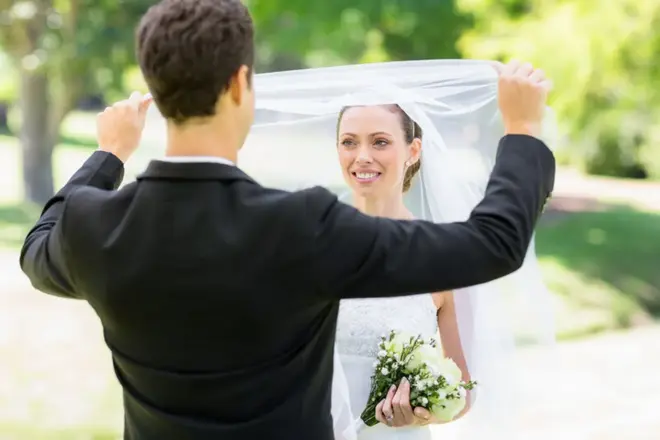
Veils are another tradition with roots in superstition. In ancient Rome, brides wore flame-colored veils called “flammeum” to ward off evil spirits. The veil was supposed to disguise the bride so that jealous spirits wouldn’t recognize her as she walked to the ceremony.
In later centuries, veils took on different meanings across cultures. In arranged marriages common in medieval Europe, a heavy veil kept the groom from seeing the bride’s face until after the vows were exchanged, reducing the chance he’d back out. Over time in Western Christianity, the veil became a symbol of modesty and purity.
Today, most brides who wear veils choose them as a fashion statement rather than a spiritual shield. Styles range from short blusher veils that barely reach the chin to dramatic cathedral-length veils that trail several feet behind the bride. Some brides skip the veil entirely and opt for hair accessories, flower crowns, or nothing at all. For a deeper look at the history and modern options, see why brides wear veils.
The Wedding Processional
The processional is the formal walk down the aisle that opens the ceremony. In most American weddings, the officiant takes position first, followed by the wedding party, the flower girl, the ring bearer, the parents, and finally the bride.
This specific order traces back to another royal wedding. When Queen Victoria’s eldest daughter, Princess Victoria, married Prince Friedrich Wilhelm of Prussia in 1858, the ceremony at St James’s Palace included an elaborate processional that was widely covered in British and American newspapers. The format caught on quickly and became the template for formal weddings throughout the English-speaking world.
The processional still carries emotional weight, even at smaller courthouse weddings where the “aisle” might be a short hallway in a government building. Proper wedding ceremony etiquette covers the expected order, but couples today often adjust the sequence to fit their situation. Some brides walk with both parents. Others walk alone. The act of walking toward your partner while the people you love watch remains one of the most emotionally charged moments of any wedding, regardless of the setting.
The First Dance
After the ceremony wraps up, the reception begins. And for many American couples, the first official act as a married pair is sharing a dance together while guests watch.
This tradition comes from 18th-century European ballroom culture. At formal balls in England and France, the guest of honor always opened the dancing. When this custom crossed over into wedding celebrations, the newlyweds became the guests of honor at their own party. They’d take the floor first, dance together, and then the rest of the guests would join in.
Some couples today choreograph an elaborate routine. Others sway slowly to a meaningful song. A few skip it entirely, which is fine too. The first dance is one of those traditions that’s easy to adapt to your comfort level. If neither of you likes being the center of attention, a short dance with a quick transition to the general dance floor works perfectly. For more inspiration, see first dance ideas that go beyond the typical slow sway.
The Wedding Cake
Wedding cakes have been part of marriage celebrations for thousands of years, though early versions looked nothing like the tiered fondant creations you see today.
In ancient Rome, wedding guests would break a barley cake over the bride’s head. The crumbs symbolized fertility and good fortune, and guests would scramble to collect the fallen pieces for their own luck. Over the centuries, the tradition evolved from flat breads to stacked sweet buns to the elaborate frosted and decorated cakes that became popular in Victorian England during the 1800s.
The cake-cutting ceremony at the reception is a relatively modern addition. The couple cuts the first slice together, symbolizing their first shared task as a married pair. Then there’s the playful feeding of cake to each other, which ranges from gentle and sweet to chaotic depending on the couple’s sense of humor.
Today, plenty of couples still go with a traditional tiered cake, but alternatives are increasingly popular. Dessert tables with cupcakes, pies, donuts, or a spread of cookies give guests more options and can cost less than a custom cake. For creative approaches, check out custom wedding cake ideas and tips on decorating your cake table.
Budget-friendly alternative: A dessert table with cupcakes, pies, or cookies can cost significantly less than a custom tiered wedding cake while giving guests more variety. Many bakeries now offer a small cutting cake for photos paired with sheet cake for serving.
Making These Traditions Your Own
The best thing about American wedding traditions is that none of them are mandatory. You can follow all eight, pick your favorites, or create something completely new. A courthouse wedding can include a first dance at a restaurant afterward. A backyard ceremony can skip the processional and start with everyone already in place. A couple who doesn’t like cake can serve pie instead.
What matters is that your wedding feels like yours. These traditions have survived for centuries because they add meaning, structure, and celebration to one of life’s biggest moments. Use the ones that resonate with you, adapt the ones that almost fit, and leave the rest behind without a second thought.
Frequently Asked Questions
What are the most common American wedding traditions?
The most common American wedding traditions include exchanging rings, wearing a white wedding dress, having a wedding party of bridesmaids and groomsmen, walking down the aisle in a formal processional, sharing a first dance at the reception, cutting a wedding cake, tossing the bouquet, and following the “something old, something new, something borrowed, something blue” rhyme. Most of these customs originated in Europe and were adopted in the United States during the 18th and 19th centuries.
Why do brides wear white wedding dresses?
Brides wear white wedding dresses because of Queen Victoria, who wore a white silk and Honiton lace gown when she married Prince Albert in 1840. Before that, brides wore whatever their best dress happened to be, in any color. Victoria’s choice was widely publicized, and within a few decades, white became the expected color for Western bridal gowns. The association between white and purity came after the trend, not before it.
Where does the “something old, something new” rhyme come from?
The “something old, something new, something borrowed, something blue” rhyme originated in Victorian-era England, with the earliest recorded version dating to 1871 Lancashire. The full rhyme ends with “and a sixpence in your shoe.” Each item carries symbolic meaning: “old” represents the past, “new” symbolizes the future, “borrowed” transfers good fortune from a happily married person, and “blue” represents faithfulness.
Do you have to follow wedding traditions at your ceremony?
No. None of the common American wedding traditions are legally required. A valid marriage in the United States requires a marriage license, an officiant authorized to perform the ceremony, and typically one or two witnesses. Everything else, from the white dress to the cake cutting to the first dance, is optional. Many couples today choose which traditions to include, modify, or skip based on their personal preferences and cultural background.
Why do weddings have bridesmaids and groomsmen?
The tradition of bridesmaids and groomsmen dates back to ancient Rome, where law required 10 witnesses at every wedding. These attendants dressed like the bride and groom to confuse evil spirits who might try to curse the couple. The superstitious purpose faded over centuries, but the custom of having close friends and family stand with the couple during the ceremony remained and evolved into the modern wedding party.