Who Can Legally Officiate a Wedding? All Your Options
Why Your Choice of Officiant Matters More Than You Think
Your wedding officiant does more than read a script. They sign your marriage license, and that signature is what makes your marriage legally valid. Choose someone who isn’t authorized in your state, and you could end up with a beautiful ceremony that carries no legal weight.
Every state sets its own rules about who qualifies as a wedding officiant. Some states are broad and flexible. Others are surprisingly strict. Before you pick anyone, whether your favorite uncle, your college roommate, or a local judge, you need to understand what your state actually requires.
Quick overview: Wedding officiants fall into four main categories: religious clergy, government officials (judges, justices of the peace, county clerks), online-ordained friends or family members, and professional celebrants. Each comes with different legal requirements, costs, and ceremony styles.
Religious Officiants: Clergy and Faith Leaders
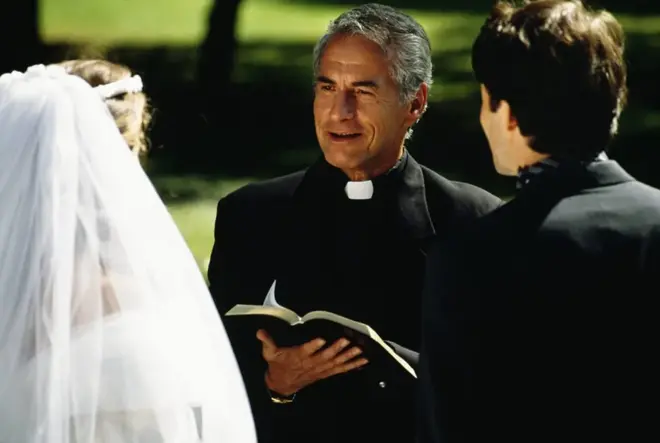
Ordained clergy are among the most widely recognized wedding officiants in the United States. This category includes priests, pastors, ministers, rabbis, imams, reverends, and deacons.
In most states, ordained clergy can perform marriages anywhere, not just inside a house of worship. A Catholic priest can marry you at a vineyard. A rabbi can officiate at a beach. The ordination itself grants the legal authority, not the location.
What to ask before you book: Every denomination has its own rules about premarital counseling, ceremony structure, and interfaith marriages. Some require months of preparation classes. Others expect the couple to be active members of the congregation. Have that conversation early so you know what you’re committing to beyond the ceremony itself.
Religious officiants typically handle the full ceremony flow, including readings, prayers, vows, and the pronouncement. If you want a personalized ceremony with your own vows, discuss that flexibility up front. Some clergy welcome custom vows. Others follow a set liturgy with no room for changes.
Civil Officiants: Government Officials Who Perform Marriages
If you want a secular ceremony, or you’re planning a courthouse wedding, a civil officiant is the most straightforward path. Government officials who can legally perform marriages include:
- Judges (federal, state, and municipal)
- Justices of the peace
- Magistrates
- County clerks and city clerks
- Mayors
- Notaries public (in select states, including Florida, Maine, and South Carolina)
Civil ceremonies tend to be short, often 10 to 20 minutes. The officiant handles the legal declarations, the exchange of vows, and the license signing. There’s no religious content unless you specifically request it, and most civil officiants are happy to keep things simple.
Availability varies by location. Not every judge or clerk performs weddings as part of their duties. Some courthouses only schedule ceremonies on specific days. Others require appointments weeks in advance. If you’re planning a city hall wedding, call ahead to confirm availability and any associated fees.
One advantage of civil officiants: they deal with marriage paperwork constantly. They know exactly how the license needs to be filled out, filed, and returned to the county clerk. That administrative experience reduces the chance of a paperwork error delaying your official marriage record.
Ordained Friends and Family Members
This is the option that has grown the fastest over the past decade. If you want someone you know and love standing at the front of your ceremony, they can get ordained online and serve as your legal officiant.
Online ordination through organizations like the Universal Life Church takes minutes and is free. Your friend or family member fills out a form, receives their ordination credentials, and is technically authorized to perform marriages.
Not every state recognizes online ordination. States like New York, Virginia, and Tennessee have upheld online ordination in various court decisions. But others, including parts of Pennsylvania and certain counties elsewhere, have challenged or rejected marriages performed by internet-ordained officiants. Check your state’s specific requirements before your chosen person applies.
Some states also require the officiant to register with the county or obtain a separate authorization letter. Skipping that step could put the legal validity of your marriage at risk.
If your state does accept online ordination, some practical advice:
- Have your officiant practice the ceremony at least twice. Reading from a phone at the altar looks exactly as awkward as it sounds.
- Walk them through the marriage license paperwork. They need to sign it correctly, and the witnesses need to sign it too.
- Build in a rehearsal so they’re comfortable with timing, pacing, and positioning.
An ordained friend can create a deeply personal ceremony. They know your story, your humor, and what matters to you as a couple. But they need preparation to pull it off well. If you’re giving a friend or family member this role, consider it one of the meaningful wedding roles you can offer.
Professional Celebrants
Professional celebrants (sometimes called life-cycle celebrants) are trained specifically to design and perform ceremonies. They sit between religious officiants and civil officiants, offering a fully customized experience without requiring any religious affiliation.
What sets celebrants apart from other officiant types:
- Custom ceremony design. A good celebrant interviews you about your relationship, your values, and what matters most. They build the ceremony from scratch based on those conversations.
- Interfaith flexibility. Celebrants can blend traditions from multiple faiths, cultures, or backgrounds into a single ceremony. If one partner is Jewish and the other is Hindu, a celebrant can weave both traditions together.
- Secular with substance. If you want a ceremony that feels meaningful without any religious content, a celebrant creates rituals, readings, and moments that carry emotional weight on their own terms.
Professional celebrants typically charge between $500 and $2,000, depending on the level of customization and the number of planning meetings. That’s a significant investment compared to a courthouse ceremony that costs under $100, but the result is a ceremony built entirely around you as a couple.
How to vet a celebrant: Ask for videos or recordings of past ceremonies. Read reviews from previous couples. Meet with them in person or by video before signing a wedding contract. The right celebrant should feel like a good fit for your personality and communication style.
What Happens If Your Officiant Isn’t Legally Recognized
This is the scenario every couple wants to avoid. If your officiant isn’t legally authorized to perform marriages in your state, your ceremony has no legal standing. You would need to get married again with a valid officiant, or visit a courthouse to make it official.
Some couples have found this out months or even years after their wedding, when they needed a marriage certificate for insurance, taxes, or other legal matters, only to learn their marriage was never properly recorded.
To protect yourself:
- Verify your officiant’s credentials with the county clerk’s office before the wedding, not after.
- Confirm they know how to handle the marriage license. The officiant must sign it, collect the witnesses’ signatures, and return it to the issuing office within the required timeframe (usually 30 to 60 days, depending on the state).
- Have a backup plan. Some couples do a quick legal ceremony at the courthouse a day or two before the main event. That way, the celebration is about the experience, and the legal paperwork is already handled.
This backup approach is more common than you might expect. Many couples who plan courthouse weddings as their legal ceremony go on to have a larger celebration with family and friends separately.
Does Your Officiant Need to Say Specific Words?
No. There is no universal legal script that makes a marriage valid in the United States. The legal requirements focus on the marriage license, the signatures, and the filing, not on the words spoken during the ceremony.
Religious and cultural traditions have shaped what most people expect to hear (“Do you take this person…”), but those phrases are customary, not mandatory. Your officiant can say whatever you’ve agreed on together, whether that’s traditional vows, something you wrote yourselves, or a simple declaration of intent.
The legal requirements for a valid marriage center on three things: a valid marriage license, the signatures of both parties and their witnesses, and the officiant returning the completed license to the county clerk. As long as those requirements are met, the ceremony language is up to you.
Planning your ceremony script: If you’re working with an ordained friend or a celebrant, discuss the ceremony wording at least a month before the wedding. This gives you time to refine the language, practice the flow, and confirm that the ceremony etiquette feels right for your guests.
How to Choose the Right Officiant for Your Wedding
Start by asking yourself three questions:
-
Do you want a religious, secular, or blended ceremony? This narrows your options immediately. If you want religious elements, you need clergy or a celebrant comfortable incorporating them. If you want a purely secular ceremony, a judge, justice of the peace, or professional celebrant works best.
-
How personalized do you want the ceremony to be? A civil officiant at the courthouse delivers a standard, efficient ceremony. A celebrant or ordained friend can create something entirely custom. Both are valid. It depends on what matters to you.
-
What’s your budget? Courthouse ceremonies often cost under $100 (sometimes just the marriage license fee). Professional celebrants range from $500 to $2,000. Religious officiants may ask for a donation to the congregation. An ordained friend might do it for free, though a thoughtful gift is always appropriate.
Once you’ve answered those questions, verify credentials, check references, and meet with your top choice before committing. The right officiant will make your ceremony feel natural, legal, and entirely yours.
If you’re still weighing whether a courthouse ceremony is the right fit, compare the pros and cons of courthouse vs. traditional weddings or get inspired by reception ideas for after the ceremony.