How Long Should Wedding Vows Be? A Practical Guide
The Sweet Spot: One to Two Minutes Each
Most wedding vows land best between one and two minutes per person. That translates to roughly 150 to 300 words, depending on how quickly you speak.
Why that range? It’s long enough to say something meaningful, and short enough that your words stay with people. Guests remember vows that are focused and heartfelt. They tune out during vows that meander into a ten-minute relationship recap. Even the person standing across from you, the one who loves you most, will start shifting their weight after the three-minute mark.
This timing holds true whether you’re standing in a courthouse ceremony or exchanging vows at a grand venue. The setting changes, but human attention spans stay the same.
The average person speaks at about 130 to 150 words per minute when reading aloud. Factor in pauses for emotion (and there will be pauses), and you’re looking at roughly 120 words per minute on the day itself. Keep that in mind when you’re timing your draft at home.
Word Count Breakdown by Style
Not all vows hit the same length, and that’s fine. Here’s a rough guide based on what you’re going for:
Short and sweet (30 to 60 seconds, 75 to 150 words): Best for couples who prefer simplicity or feel nervous about public speaking. You can say something powerful in under a minute. “I choose you, I’ll stand by you, I love who we are together.” That’s a complete vow.
Standard length (1 to 2 minutes, 150 to 300 words): Room for a personal touch, a brief story, and your promises. This is where most couples land, and it works well for city hall weddings where the ceremony itself runs 15 to 30 minutes total.
Extended (2 to 3 minutes, 300 to 450 words): Gives you space for humor, a longer story, or a poem. Be honest with yourself here: if you’re not a confident speaker, three minutes in front of a crowd will feel much longer than it reads on paper.
Anything over three minutes is a gamble. Even beautifully written vows lose their impact when they stretch too long. If you’ve written something that clocks in at five minutes, that’s a love letter. Read it privately, and trim the vows.
How to Structure What You Want to Say
A strong set of vows usually covers three things, in this order:
A moment from your past together. Not the whole story. One specific memory that captures why this person matters to you. The Tuesday they showed up with soup when you were sick. The road trip where everything went wrong and you laughed the whole time. Specificity is what makes vows feel real.
What you’re looking forward to. Marriage changes the shape of your life. What does that future look like to you? This doesn’t need to be grand. “I’m looking forward to Sunday mornings with you for the rest of my life” hits harder than sweeping declarations about eternity.
Your promises. This is the actual vow part. What are you committing to? Be concrete. “I promise to listen before I react” means more than “I promise to love you forever.” Everyone promises forever. Promise something that shows you know your partner.
Matching Length With Your Partner
Here’s a common worry: one person writes a paragraph, the other writes a novella. That imbalance can feel awkward in the moment, even if both sets of vows are good on their own.
You don’t need to share your vows ahead of time if you want to keep the surprise. But agree on a general target. “Let’s both aim for about 200 words” gives you enough structure without spoiling anything. You could also agree on a time range, like “between one and two minutes each.”
If you’re working with an officiant, they can help coordinate this. Many officiants ask couples to stay within the same ballpark so the ceremony flows naturally.
One practical approach: each person writes their vows independently, then shares just the word count (not the content) with their partner a week before the ceremony. If one of you is at 120 words and the other is at 400, you have time to adjust without anyone feeling rushed or pressured to pad their words.
Writing Tips That Actually Help
Read it out loud while you write. Vows are spoken, not read silently. A sentence that looks good on paper might feel clunky when you say it. Time yourself with your phone. You’ll probably speak faster than you expect, especially with nerves factored in.
Cut the filler first. If a sentence starts with “I just want to say that…” or “I think what I really mean is…”, delete everything before the actual point. Your vows will get tighter and stronger with every pass.
Write long, then edit short. Get everything out in a first draft without worrying about length. Then trim. Cutting is easier than adding, and the best lines usually survive the editing process because they carry the most weight.
Skip the inside jokes. A reference that makes your partner laugh but leaves 50 guests confused doesn’t belong in vows. Save those for your private moment or your reception toast.
Avoid cliches. “You complete me,” “my other half,” “I knew from the moment I saw you.” These phrases have been used so many times they’ve lost their meaning. Say what’s true for you in your own words, even if it feels less polished. Authenticity always beats eloquence.
When to Start Writing
Give yourself at least three to four weeks. That sounds like a lot for 200 words, but vows benefit from distance. Write a draft, set it aside for a few days, then come back to it. You’ll spot the weak spots immediately.
Practice reading your vows at least five times before the ceremony. Practice in front of a mirror, in the shower, on a walk. The more familiar the words feel in your mouth, the less likely you are to rush through them or lose your place on the day.
If you’re planning a courthouse wedding, the compressed timeline of these ceremonies makes rehearsal even more important. You want your vows to feel natural, not like you’re reading a school report.
Delivering Your Vows on the Day
Even perfectly written vows can fall flat if the delivery goes sideways. A few things to keep in mind for the ceremony itself:
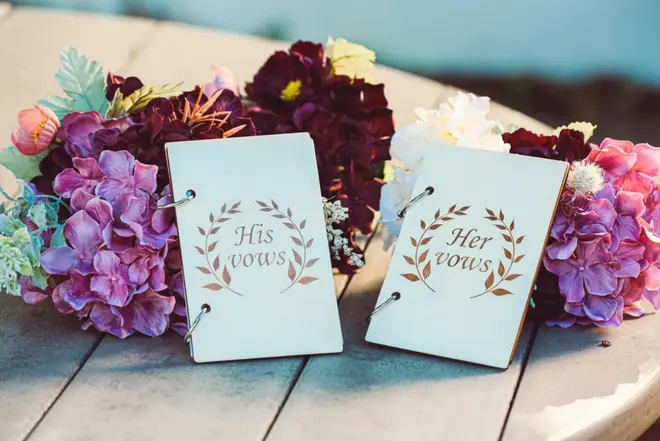
Bring a printed copy. Memorizing your vows sounds romantic, but nerves can wipe your memory clean. Print them on a nice card or write them in a small notebook. Nobody will judge you for reading, and your partner would rather hear the words than watch you struggle to remember them.
Slow down. Adrenaline makes everyone speak faster. Consciously pace yourself. Pause between sentences. Let the words breathe. The silence between your promises is where the emotion lives.
Look up. You don’t need to maintain eye contact for the entire reading, but lift your eyes from the page at key moments, especially when you say your partner’s name or deliver your main promise. That connection is what people remember.
It’s okay to cry. If your voice cracks or you need to pause, take a breath and keep going. Those moments aren’t mistakes. They’re proof that the words mean something. Your wedding guests will be crying right along with you.
Making Your Vows Feel Like You
The best wedding vows don’t sound like wedding vows. They sound like one person talking honestly to another. If your draft reads like something from a greeting card, start over. If it reads like something you’d actually say to your partner on a quiet evening at home, you’re on the right track.
Length matters less than sincerity. A 100-word vow that makes your partner cry will always outperform a 500-word vow that makes your guests check their phones. Say what you mean, say it clearly, and trust that the moment will do the rest.
Frequently Asked Questions About Wedding Vow Length
How many words should wedding vows be?
Most wedding vows work best at 150 to 300 words per person. That range takes about one to two minutes to read aloud at a natural pace, leaving room for a personal memory, a look at the future, and your actual promises.
Should both partners write the same length vows?
Both sets of vows should be roughly the same length, though they don’t need to match word for word. Agreeing on a target range (like 150 to 250 words) before writing prevents one partner from delivering a quick paragraph while the other reads for four minutes.
Can wedding vows be too short?
Wedding vows can be as short as a few sentences and still carry real meaning. A 75-word vow that names a specific promise (“I will always listen before I react”) can feel more personal than a 400-word vow filled with generic phrases about love and forever.
Is it better to memorize vows or read them?
Reading from a printed card or small notebook is the safer choice. Nerves and adrenaline can blank your memory mid-ceremony, and your partner would rather hear every word than watch you struggle to recall them. Most officiants recommend bringing a written copy as backup at minimum.
When should I start writing my wedding vows?
Start writing at least three to four weeks before your ceremony. Vows benefit from multiple drafts with time in between. Write your first version, set it aside for a few days, then return and edit. Practice reading aloud at least five times before the wedding day.